


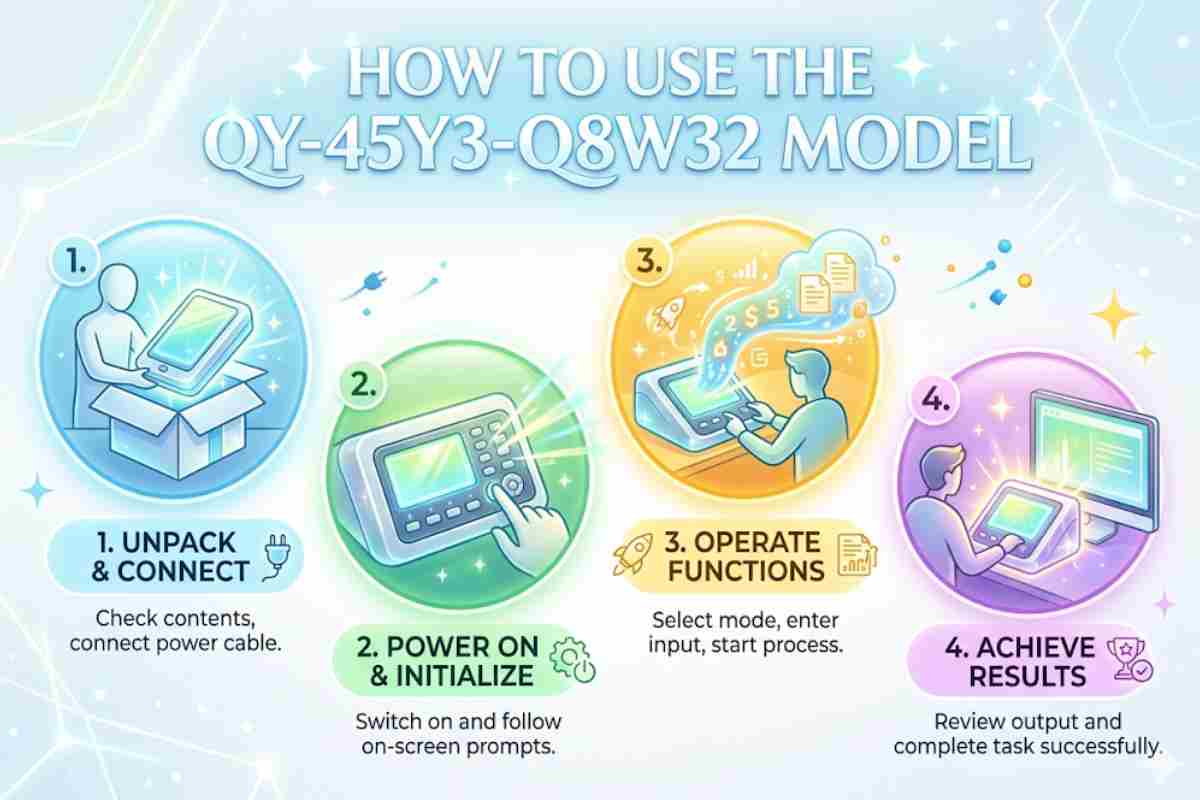
QY-45Y3-Q8W32 is a high-accuracy industrial-grade output module used for automation and control systems, relay commands, and digital output signals processing. Module generally finds its place within PLCs, on the assembly line in a factory, within electrical distribution boards, and various industrial automated systems where accuracy, strength, and fast processing speed of signals is critical. The module has been built to function as part of a fully automated system, and it is known for its robust design, multiple channel output, and high signal response rate.
In the current world scenario, where most professionals and engineers are required to have highly automated systems, instant control, and high-speed processing, complete knowledge about the module wiring and setup procedure, along with usage and maintenance, is crucial. Let us understand a step-by-step procedure to extract full functionality of the module, be it for a brand new setup or an upgrade.
Table of Contents
Understanding the Keyword and User Intent
When you search for how to use qy-45y3-q8w32 model, you are not looking for theory. You want a clear path from setup to real use. You’ve used or will use the model shortly, and the only thing you want is to get a sound output without wasting resources in trial and error. The intent is practical.
You want to know what inputs to give, how to control results, and how to avoid mistakes. The real problem is confusion. Most models come with limited guidance, unclear parameters, and too many options. This guide shows simple steps, real examples, and small changes that improve results.
Key Features of QY-45Y3-Q8W32 Model
| Feature | Description | Benefit / Use Case |
| Multiple Output Channels | Allows for setup configuration of 8 or 16 or 32 output channels, based on configuration. | Ability to control more devices (e.g. Motors, relays, alarms) at the same time |
| High-Speed Switching | Response time of under 1mS | Good for real-time control and time critical processes |
| Signal Interfacing Capability | Converts controller signals into real-world device actions | Bridges PLC systems with physical hardware efficiently |
| Electrical Isolation | Protects CPU and connected modules from voltage spikes | Improves safety and prevents system damage |
| Overload & Short-Circuit Protection | Built-in protection mechanisms against overcurrent issues | Enhances reliability and reduces risk of failure |
| LED Status Indicators | Each output channel has real-time LED indicators | Easy monitoring and quick diagnostics |
| Configurable Parameters | The timing, thresholds and response characteristics are all settable | Adaptable to varying industrial applications |
| Modular Design | Components can be removed and added to the system without any disruption | Upgradeable/Maintainable and scalable |
| Robust Industrial Build | Noise, vibration and temperature immune | Built to withstand rigorous industrial environments |
| PLC Integration Compatibility | Works with tools like GX Works, TIA Portal, RSLogix | Easy integration into existing automation systems |
Primary Use Cases:
- Factory Automation: Drives actuators or motor contactors based on PLC logic.
- HVAC Systems: Sends control outputs to dampers, heaters, and fans.
- Elevator control panels: Controls both the floor display signals and the door operators.
- Packaging machinery: Will cooperate with both the conveyor belt, timer, and indicator signals.
- Water treatment plants: Will control the pumps, dosers, and alarms.
By understanding this the engineer and integrator can properly define its operation within the control system and application.
Pros and Cons of QY-45Y3-Q8W32 Model
| Pros | Cons |
| High processing capability for automation tasks | Requires technical knowledge to set up and use |
| Flexible configuration for multiple use cases | Initial setup can be time-consuming |
| Supports integration with external systems | Compatibility issues may arise with some devices |
| Scalable performance (can handle simple to advanced tasks) | Needs regular calibration and maintenance |
| Real-time processing and control | Errors can occur if misconfigured |
| Suitable for both industrial and DIY applications | Documentation may be limited or unclear |
| Customizable inputs and outputs | Learning curve for beginners |
| Efficient for IoT and smart automation workflows | May require additional hardware/modules |
| Cost-effective compared to enterprise systems | Limited support compared to major platforms |
| Can be optimized for high accuracy | Performance depends heavily on correct setup |
Pre-Installation Requirements: Safety, Tools, and Environment Readiness
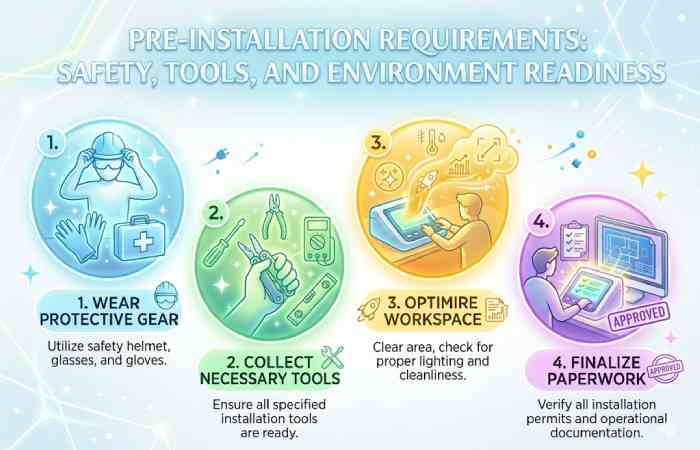
Installation environment preparation, tool collection, compatibility checks need to be done before installation so that downtime, devices break down.
Required Tools and Accessories:
- Screwdrivers (flat-head and Phillips)
- DIN rail mounting brackets
- Shielded wires for output connections
- Wire strippers, labels, and terminal crimpers
- Voltage meter for power verification
Documentation to Prepare:
- Product datasheet and installation manual
- Panel layout diagrams
- PLC wiring guide and I/O addressing list
These tests performed by the installer, and acquiring the necessary equipment, helps ensure a safe, clean installation.
Alternatives to QY-45Y3-Q8W32 in the Philippines
| Attribute | Arduino OPTA RS485 Micro PLC | Siemens LOGO! 24CE PLC | Mitsubishi FX1N-14MR PLC | Selec MM3032 PLC | XINJE XD3 PLC Controller |
| Type | Micro PLC (IoT-ready) | Compact PLC | Industrial PLC | Entry PLC | Budget PLC |
| Best For | Smart automation & IoT | Small machines | Factory automation | Small systems | Cost-sensitive setups |
| Price (PHP approx.) | ₱11,000–₱13,000 | ₱6,000–₱70,000 | ₱10,000–₱50,000 | ₱6,500–₱8,000 | ₱7,000–₱9,000 |
| Connectivity | RS485, Modbus TCP/RTU | Ethernet, basic I/O | Serial, expansion modules | Standard I/O | RS485, Modbus |
| Programming | IEC 61131-3 + Arduino IDE | Ladder logic | Ladder logic | Ladder logic | Ladder logic |
| Scalability | High (modular IoT) | Moderate | High | Moderate | Moderate |
| Ease of Use | Medium | Beginner-friendly | Intermediate | Beginner | Beginner |
| Availability in Philippines | Online + import | Authorized distributors | Widely available | Local suppliers | Import + resellers |
| Resource Link | https://store.arduino.cc/products/opta | https://new.siemens.com/logo | https://www.mitsubishielectric.com | https://www.selec.com | https://www.xinje.com |
Step-by-Step Guide: How to Use QY-45Y3-Q8W32 Model
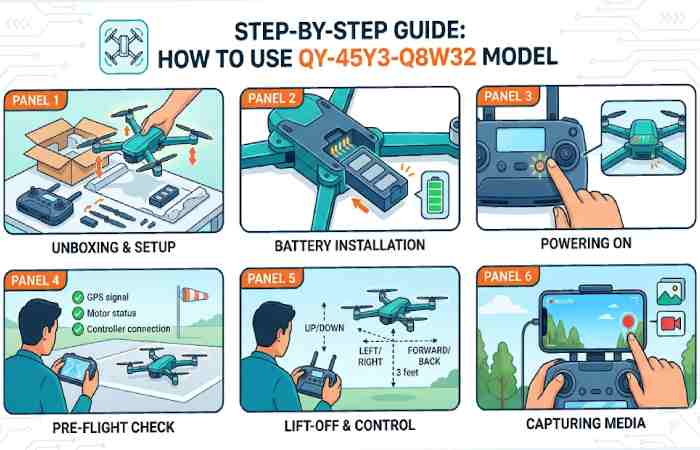
- Initial Setup
Before using the model, ensure you have:
- Compatible system/environment
- Required software or firmware
- User manual or configuration file
Steps:
- Unbox or initialize the model
- Connect to power/source system
- Install required drivers/software
- Verify system compatibility
- Configuration Process
Proper configuration ensures optimal performance.
Basic Configuration Includes:
- Input parameters setup
- Output channel selection
- Performance tuning settings
Example Configuration Table
| Parameter | Recommended Setting | Purpose |
| Input Mode | Auto/Manual | Controls data input |
| Output Level | Medium/High | Determines performance |
| Calibration | Enabled | Ensures accuracy |
- Calibration & Testing
Calibration is crucial for accuracy.
Steps:
- Run initial diagnostics
- Adjust sensitivity levels
- Test with sample inputs
- Validate output results
- Daily Usage Workflow
Once configured, follow this workflow:
- Start the system
- Load input data or parameters
- Run the model
- Monitor outputs
- Adjust settings if needed
- Advanced Optimization Tips
To maximize performance:
- Use batch processing for efficiency
- Enable auto-adjust features if available
- Monitor system logs regularly
- Keep firmware/software up-to-date.
Regular Maintenance Schedule:
- Service terminals with contact cleaner every 3-6 months.
- Inspect and tighten terminal screws during annual service.
- Replace any suspect cables/connections as preventive maintenance.
Firmware & Software Maintenance:
- Use OEM software to check for updates
- Update PLC project files if firmware changes
- Back up all configurations before applying updates
Best Practices:
- Do not enable all channels simultaneously.
- When driving inductive loads (like relays or solenoids), place a snubber on them.
- Store unused modules in their original anti-static packaging, at room temperature.
Following this rule, the modules will last for years.
Competitors & Alternatives
| Attribute | Arduino OPTA RS485 Micro PLC | Brainboxes BB-400 Industrial Controller | Selec MM3032 PLC 24V | Industrial ESP32-S3 Control Board | FX1N-20MT PLC Controller |
| Type | Micro PLC (IoT-ready) | Smart industrial controller | Standard PLC | Embedded control board | PLC controller |
| Best For | IoT + automation projects | Enterprise/industrial systems | Small–mid automation | DIY & prototyping | Budget industrial use |
| Price Range | ₹17,000–₹18,000 | ₹40,000+ | ₹9,000–₹10,000 | ₹4,000–₹5,000 | ₹6,000–₹7,000 |
| Connectivity | RS485, Modbus TCP/RTU | Ethernet, serial | Basic PLC I/O | WiFi, Bluetooth, RS485 | Standard PLC ports |
| Programming | IEC 61131-3 PLC languages | Advanced industrial software | Ladder logic | C/C++ (embedded) | Ladder logic |
| Scalability | High (modular IoT) | Very high | Moderate | Limited | Moderate |
| Ease of Use | Medium | Advanced users | Beginner-friendly | Technical users | Beginner–intermediate |
| Use Case | Smart factories, IoT | Large-scale automation | Machines, control panels | Custom automation builds | Small factories |
| Resource / Vendor | Arduino Official / Amazon | Industrial supplier | VoltKart / distributors | Robotics stores | Amazon / PLC vendors |
Wiring the QY-45Y3-Q8W32 Model for Digital Output Operations
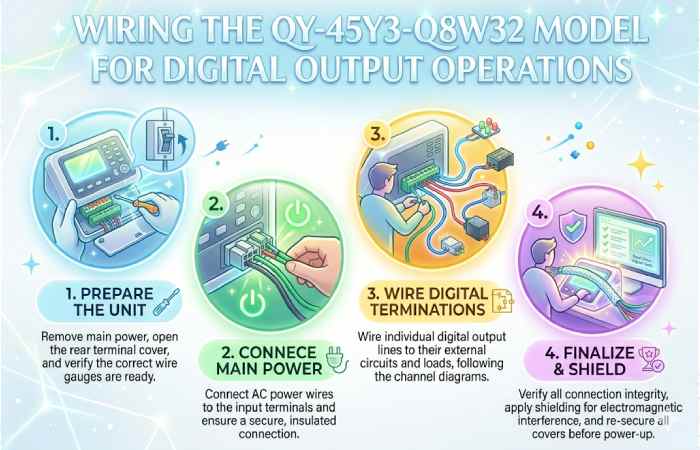
Improper wiring could cause potential electrical danger and can affect signals and performances.
Output Wiring Steps:
- Choose your output terminals (e.g., Y0 – Y15).
- Connect components such as relay, solenoid or an alarm to each channel.
- When the connections are far apart it is best to use a twisted-pair or shield type cable.
- Connect the common terminal (COM) to the common ground/neutral.
Power Supply Connection:
- Match input power to specification (e.g., 24VDC with polarity observed).
- Fuse protection should be rated based on module current draw + device load.
- Use a regulated and filtered power supply to prevent voltage spikes.
Additional Wiring Tips:
- Label each wire for future troubleshooting.
- Bundle wires using cable ducts to maintain organization.
- Check continuity of the test before supplying power.
Wiring faults are the most frequent cause of module failure – great care needs to be taken here.
Troubleshooting Guide
| Issue | Possible Cause | Fix |
| Model not starting | Power/config issue | Check connections |
| Incorrect output | Calibration error | Recalibrate |
| Slow performance | Overload | Reduce input load |
| System crash | Software bug | Update firmware |
Real Example from Start to Finish
Goal: Create a short guide.
Step 1: Input: “Write a guide.” Result: Too broad.
Step 2: Input: “Write a 150-word guide on saving money.” Result: Better, but still general.
Step 3: Input: “Write a 150-word guide on saving money for beginners using simple language and 3 tips.” Result: Clear and usable.
You improved the output by refining the input.
FAQs
- Is the QY-45Y3-Q8W32 model beginner-friendly?
It can be used by beginners, but initial setup may require guidance.
- How long does setup take?
Typically 20–60 minutes depending on experience level.
- Do I need regular maintenance?
Yes, periodic calibration and updates are recommended.
- Can it integrate with other systems?
Yes, most configurations support external integrations.
- How long will the model last?
With reasonable maintenance, it should last a few years.
Conclusion
The QY-45Y3-Q8W32 digital output is a high-performance unit suited for robust industrial and electronic control systems. For all aspects of automation, whichever move you make, good pre-installation, software configuration, wiring modes, troubleshooting and maintenance capabilities would guarantee a smooth operation and success of the whole automation system. Properly used, it helps enhance both the system’s productivity and safety and extend its lifetime.