


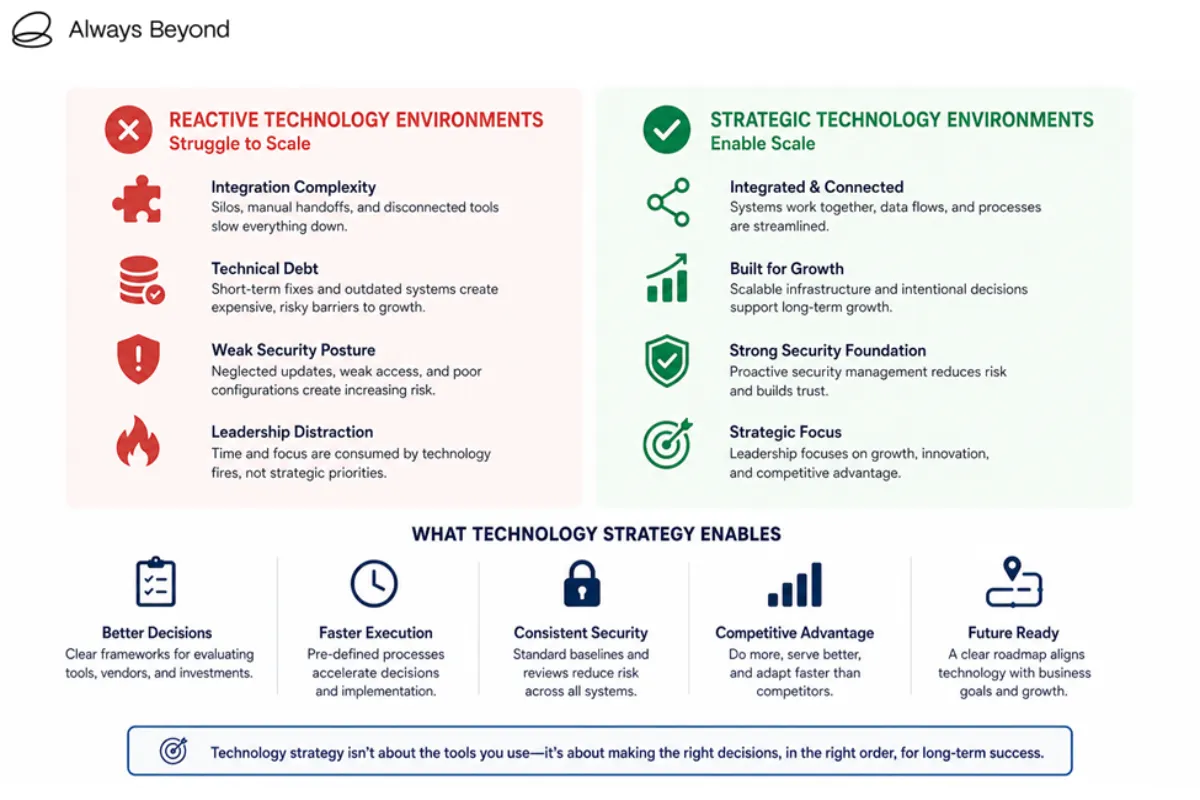
The gap between businesses that scale well and businesses that stall is rarely the product, the market, or the team. Those are the visible explanations. The underlying cause, in many cases, is the technology foundation — and whether it was built to support growth or whether it became the thing that prevented it.
This isn’t a subtle force. It shows up in specific, tangible ways: hiring that can’t happen because the systems to support new employees aren’t ready, client relationships that stall because operational capabilities don’t match what was promised, leadership cycles consumed by technology fires instead of strategic decisions. The businesses on the right side of this pattern tend to have invested in technology strategy as a deliberate discipline. The ones on the wrong side tended to let technology grow by accumulation.
Table of Contents
Why Reactive Technology Environments Struggle to Scale
A technology environment built reactively — tool by tool, decision by decision, in response to immediate needs — tends to develop characteristics that make scaling difficult.
Integration complexity is the most common problem. Fifteen tools acquired individually, without a coordinated architecture, typically don’t work well together. Data lives in silos. Workflows require manual handoffs between systems. Reporting requires aggregating information from multiple sources that don’t agree on definitions. Each new tool added to the environment makes the integration problem slightly worse.
Technical debt accumulates quietly. Individual decisions that seemed reasonable at the time — choosing the cheaper option, working around a limitation instead of fixing it, using a system past its useful life — compound into structural constraints. The business that was fine at twenty employees hits a ceiling at sixty because the systems it’s built on weren’t designed for that scale and replacing them mid-operation is expensive and risky.
Security posture degrades by neglect. No single decision makes an environment insecure. It’s the combination of unpatched systems, overly broad access permissions, unmonitored services, and security configurations that were appropriate once and are no longer adequate. Addressing these individually doesn’t help much if the underlying posture isn’t managed holistically.
What Technology Strategy Actually Enables
Effective it strategy consulting doesn’t produce a technology plan — it produces a framework for making technology decisions consistently and well over time. That’s a more valuable output than any specific plan, because decisions don’t stop when the plan is written.
A strategy framework answers the recurring questions before they become urgent: What’s our standard for evaluating new software? How do we assess build vs. buy vs. outsource? What security baseline applies to all systems? What’s our data architecture and how do new tools fit into it? What’s our upgrade path for infrastructure that’s approaching end of life?
When these questions have pre-established answers, decision-making accelerates. The evaluation process for a new software tool isn’t reinvented every time — it follows a framework. The security review of a new vendor isn’t ad hoc — it runs through a checklist. The business can move faster because it’s not starting from scratch on every technology decision.
The Connection Between Technology and Competitive Position
Technology strategy has a competitive dimension that often gets lost in conversations focused on cost and operations.
The businesses that use technology most effectively don’t just run better — they do things their competitors can’t. They can handle more volume with the same team because their processes are better automated. They can serve customers more responsively because their data is better organized and accessible. They can enter new markets faster because their infrastructure is flexible rather than rigid.
This is the compounding advantage of strategic technology investment. In year one, the difference between a strategically designed technology environment and a reactive one might not be obvious. In year three or five, the divergence in capability is often substantial.
The flip side is also true. Organizations that have deferred strategic technology investment often find themselves in a position where catching up requires significant disruption — replacing core systems, rearchitecting integrations, addressing accumulated security debt — at exactly the moment when business growth should be the focus. It’s an expensive problem to have.
How to Approach Building Technology Strategy
The most practical starting point for technology strategy is an honest assessment of the current state — not an aspirational picture, but an accurate one.
What systems are actually in use? How do they integrate, and where are the gaps? What are the genuine security exposures? What are the infrastructure constraints that will limit scaling? What are the costs, and are they producing commensurate value?
This assessment is often uncomfortable because it surfaces decisions that should have been different. That discomfort is worth tolerating. A strategy built on an accurate baseline produces better recommendations than one built on a flattering picture.
From there, the strategy maps the gap between current state and what the technology environment needs to look like to support the business in three years. It sequences the work, identifies the dependencies, and connects each initiative to a business rationale.
The sequencing is important. Not everything can happen at once, and the wrong sequencing creates its own problems. Security improvements that require infrastructure changes shouldn’t wait for a complete infrastructure overhaul — they need to happen on a timeline driven by risk. Integration work that unblocks a growth initiative should take priority over optimization of something that’s working adequately.
The businesses that scale well aren’t necessarily the ones with the best technology. They’re the ones that have thought carefully about what technology they need, built it with intention, and managed it as a business asset rather than an overhead function. That discipline — applied consistently over time — is what separates the ones that scale from the ones that stall.