


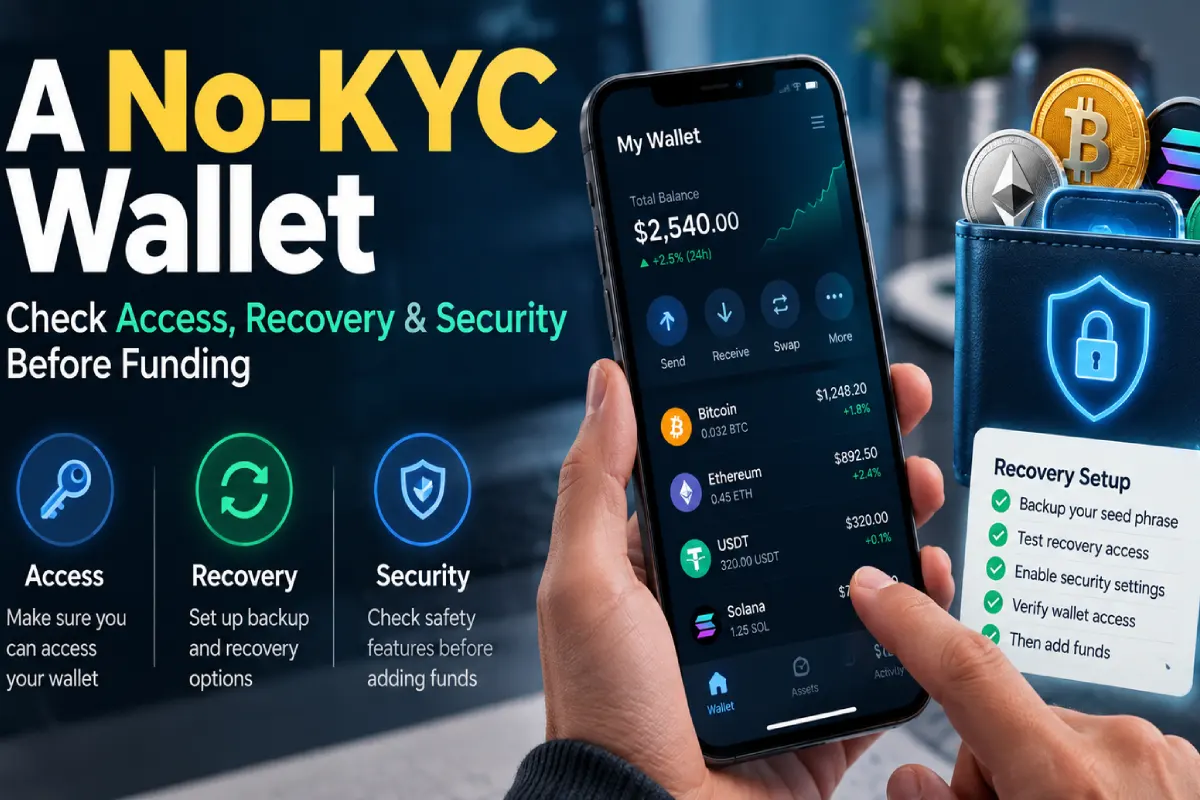


Choosing a no-KYC wallet is a decision about access and responsibility, not a shortcut around every identity, security or legal question. “No verification” may describe the wallet’s own onboarding flow, while exchanges, payment providers and merchants involved before or after a transaction can operate under different rules.
Table of Contents
Ask what the wallet actually controls
| Model | User responsibility | Question before use |
|---|---|---|
| Self-custody software | Protecting recovery material and transaction approvals | Can the owner recover safely after device loss? |
| Hardware-assisted setup | Protecting the device, backup and verification steps | Does the workflow match the user’s technical habits? |
| Custodial account | Protecting account access and understanding provider terms | Who controls withdrawals and recovery? |
Verification is not a privacy score
Whether an app asks for identity information is only one factor. Privacy also depends on software source, device hygiene, how an address is shared, network visibility and the services used alongside the wallet. A privacy claim that does not explain its limits is less useful than a clear description of what the user controls.
It also helps to separate three questions that are often blended together. Account onboarding asks what an app collects when someone creates access. Transaction privacy concerns what can be observed from an address or public network. Personal security concerns whether another person can obtain the device, password or recovery material. A choice that improves one of these areas does not automatically solve the other two.
Read the claim as a set of practical questions
| Claim a user may see | Useful follow-up | Why the distinction matters |
|---|---|---|
| “No account required” | Does the wallet create local keys, and where are they backed up? | Local setup can reduce account dependence but increases backup responsibility. |
| “Private wallet” | What information is visible on the relevant network and to connected services? | Privacy is not a promise that activity is invisible everywhere. |
| “Easy recovery” | What is needed to restore access, and who can see that material? | A convenient recovery path can be unsafe if secrets are exposed. |
| “Multi-chain support” | Which assets and networks are supported in this version? | Asset names can look similar while transfer routes remain incompatible. |
A clear answer is more valuable than a marketing label. Before funding a new wallet, a user should know whether its keys are held locally, whether a provider can freeze or restore access, and which step would be necessary if the original device disappeared. Those answers create a more realistic picture of both autonomy and risk.
Map the whole route, not just the wallet screen
Funds usually reach a wallet from another service and later leave for another address, exchange or merchant. Each part of that route can have its own terms, security controls and information requirements. The responsible approach is to review the specific service being used and comply with applicable requirements rather than assuming a wallet label changes every other participant’s rules.
- Write down the asset, network and destination for the intended transfer.
- Confirm that the sending and receiving services both support that exact route.
- Use a small test amount when an error would be expensive or irreversible.
- Verify the final address through a second trusted view, not only a pasted value.
- Keep records appropriate to the user’s circumstances and local obligations.
Device discipline carries much of the security burden
A self-custody wallet can be undermined by a compromised browser, a fake installer or a shared device. Routine maintenance is not glamorous, but it makes the wallet’s security assumptions more realistic: use current operating-system updates, restrict who can unlock the device, remove unneeded extensions and download software only from a verified official source. If a device cannot be kept under reasonable control, it may not be suitable for a frequently used wallet.
Decide what to do if something changes
Good plans include a response to ordinary disruption. A stolen phone, a failed laptop, an accidental software deletion and a suspected phishing attempt call for different actions. The recovery information should remain available to the owner without being kept in the same place as the device. If compromise is suspected, moving funds from a known-good environment may be prudent; no online guide can determine that for a particular situation, so users should avoid rushed decisions and verify official support channels independently.
Recovery is the decisive test
- Identify what recovery information is created at setup.
- Store it offline, privately and away from ordinary device backups.
- Plan for a lost computer or phone before depositing funds.
- Never enter recovery words into a form, chat, browser extension or support message.
- Review the plan after a device change or change in the value held.
Common traps
| Trap | Reason to pause |
|---|---|
| “Anonymous and risk-free” marketing | No wallet can make every transaction or obligation disappear. |
| Recovery help requiring a seed phrase | The phrase gives full access and must remain private. |
| Unknown download or browser extension | Software-source risk can defeat otherwise sound custody habits. |
| Unclear asset or network support | Sending on the wrong route can create irreversible problems. |
Conclusion
A no-KYC wallet should be assessed through its control model, recovery process and realistic privacy limits. The best setup is one the holder can operate safely, document clearly and recover without handing its secrets to another party.
Kashifa Jafar
Kashifa Jafar is a business and digital trends writer at Businessian with 4+ years of experience in content writing and digital publishing. She covers business, entrepreneurship, marketing, e-commerce, digital trends and practical topics that help readers better understand the changing business landscape.
View Author Profile →
Sameena Begum
Sameena Begum is a business and digital content reviewer at Businessian. She reviews selected content for clarity, organisation, consistency, readability and overall editorial quality.
View Reviewer Profile →